
Real-world Use Cases Of Karpenter
AWS Karpenter is revolutionizing node management within the Kubernetes ecosystem by introducing adaptive autoscaling capabilities as an open-source solution. It streamlines and automates the node management process, eliminating the need for node group abstractions by directly interacting with the AWS EC2 fleet API for efficient node provisioning.
With the amazing benefits that Karpenter offers, it has contributed to many real-life use cases. This blog covers Karpenter’s role in Kubernetes and the real-world use cases it offers.
What is the role of Karpenter in Kubernetes?
Karpenter plays a vital role in simplifying the resource scaling process within Kubernetes clusters by automating the management of diverse spot instances, node pools, and resources. Before the introduction of Karpenter, Kubernetes users faced the arduous task of manually adjusting cluster computing capacity, relying on Kubernetes Cluster AutoScaler or Amazon EC2 Auto Scaling Groups. This approach proved to be complex, time-consuming, and limited in functionality.
However, with the integration of Karpenter, a seamless combination of unscheduled pod resource requests and automated decision-making for launching new nodes or terminating existing ones becomes achievable. This automation effectively reduces infrastructure costs and scheduling latencies.
Thus, by utilizing Karpenter, Kubernetes users can streamline their resource scaling workflows, significantly improving operational efficiency and optimizing resource allocation within their clusters.
Related Content
The Ultimate Guide to Karpenter
Maximizing efficiency, stability, and cost savings in Kubernetes clusters
Download Now
What Are The Real-World Use Cases Of Karpenter?
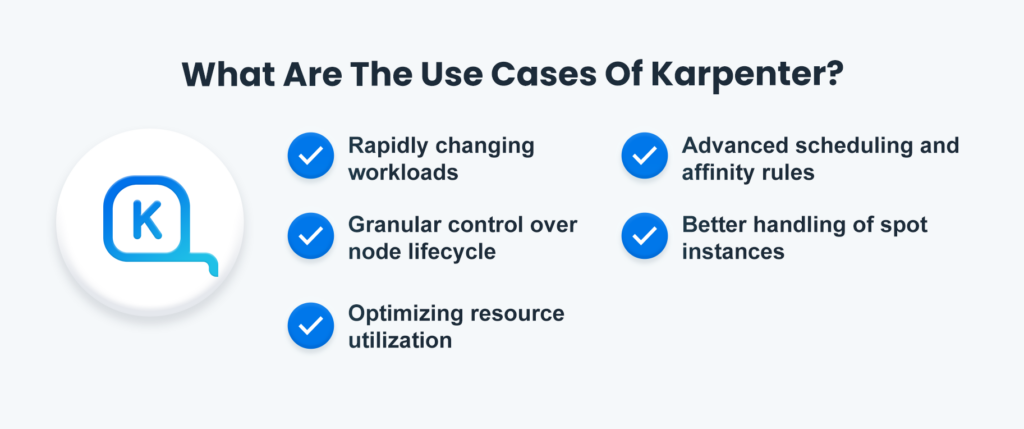
Karpenter offers a range of real-world use cases demonstrating its value and versatility in effectively managing Kubernetes clusters. Some prominent use cases of Karpenter include:
- Rapidly changing workloads: Karpenter takes a proactive approach to node provisioning, enabling it to swiftly adapt to fluctuating workload demands. If your Kubernetes cluster frequently experiences shifts in resource requirements or has workloads characterized by short-lived, high-intensity bursts, Karpenter ensures more efficient scaling to meet those dynamic demands promptly.
- Granular control over node lifecycle: Karpenter provides fine-grained control over node termination through its Time-To-Live (TTL) settings. This can be useful for scenarios where you need to manage node lifecycles based on factors such as cost considerations, usage patterns, or scheduled maintenance, allowing for fine-grained control over resource utilization.
- Optimizing resource utilization: Karpenter’s customizable scaling policies and support for diverse instance types can help optimize resource utilization in your cluster. If you need to manage various workloads with different resource requirements, Karpenter can help ensure that your cluster provisions nodes tailored to your workloads’ needs.
- Advanced scheduling and affinity rules: Karpenter supports advanced scheduling and affinity rules to help you better manage workload placement and resource allocation in your cluster. If you have specific requirements for workload distribution or need to enforce strict resource constraints, Karpenter provides the flexibility to handle these scenarios.
- Better handling of spot instances: Karpenter’s approach to spot instances offers better cost optimization and flexibility compared to the Cluster Autoscaler. Karpenter can automatically provision a mix of on-demand and spot instances, dynamically choosing the most cost-effective options that meet your workloads’ resource demands.
These capabilities collectively contribute to a more streamlined and efficient management of your Kubernetes clusters.
Optimize EKS with nOps
nOps makes it easy to understand and optimize all of your cloud costs.
Maximize savings. nOps continuously layers commitments in small hourly increments to capture 55%+ savings while minimizing overcommitment risk — even for dynamic workloads
Results-based pricing model: Customers typically save ~20% more by switching to nOps — and you pay only when you get better results.
Free Savings Analysis: Quantify exactly how much more you can save for no work on your part. We optimize, and you get the credit.
You can book a free savings analysis to find out how nOps can help you start saving today!
nOps processes over $4 billion in cloud spend and was recently named #1 in G2's cloud cost management category.
Real-world Use Cases Of Karpenter